Thursday, March 9, 2017

Political Conflict in Libya


Many people may not be aware of the current political unrest in Libya, and the militant fight for power since 2014. Libya has been in a state of civil war since 2014, with multiple rival parties fighting for control of Libya and its resources. Most recently however, there has been a battle over the highly lucrative oil terminals located in Libya. The terminals were originally under the control of Field Marshal Khalid Haftar. Haftar is the leader of the Libyan National Army (LNA), and gains his support from Eastern Libya as well as countries like Russia and Egypt. The “attackers” who took control of the oil terminals were led by the Benghazi Defense Brigades (BDB). The BDB is made up mostly of Libyans who were forced to leave their homes as a result of Haftar’s takeover of Benghazi. This week the BDB both took over control of the Al Sidra and Ras Lanuf oil ports, but also launched multiple air raids on many cities in Eastern Libya.


Since there is a split government ruling body, there are constant conflicts from armed militant groups. Countries like Egypt are calling for a cease-fire and have condemned these attacks on Libya’s oil terminals, however both parties are reluctant to come to a compromise. Libya currently produces approximately 700k barrels per day, however this number may be subject to change due to the geopolitical issues in Libya. The Libyan National Oil Corporation (NOC) has not released an official statement, however oil production in Libya is suspected to decrease throughout 2017.

- Allison Kosic

Sources:

Nike's Pro Hijab

by Nicolette Mehran

            As we all know, much of the Middle East follows the beliefs of Islam. In some countries, it is required by law that women cover themselves from head to toe, but in others, it is not, despite the fact that some women choose to cover themselves anyway. However, Muslim women are not just confined to the Middle East; they exist all around the world and are some of the most powerful, accomplished women in the world as well, taking on roles as government officials, activists, educators and scholars, and professional athletes. However, for athletes in particular, wearing a hijab can become quite difficult and cumbersome. But, Nike found a solution.

Ibtihaj Muhammad

            Professional fencer Ibtihaj Muhammad was the first Muslim United States athlete to compete in the Olympics while wearing a hijab, paving the way for women to follow in her footsteps and empowering women around the world to be proud of their heritage and their beliefs. However, Muhammad has stated that, because of her modest Muslim apparel, she has had a hard time feeling like part of a team or finding clothing that was appropriately suited for athletic purposes. However, Nike, a company that knows how clothing can affect an athlete, has decided to take matters into its own hands and created what it calls a “Pro Hijab” for Muslim women that will be launched in Spring 2018. It is made of a breathable material that helps to wick away sweat, featuring an elastic band that allows for adjustment for various activities or wear underneath another athletic garment. This product was tested by several Middle Eastern women from various athletic fields such as Zahra Lari (a figure skater), Manal Rostom (a runner), and Amna Al Haddad (a weight-lifter). This hijab is part of Nike’s new campaign for Middle Eastern women that highlights five female professional athletes with the slogan “What will they say about you?”, a question many women in the region face on a regular basis.

Zahra Lari

Manal Rostom

            Day by day, women prove themselves to be smart, powerful, and worthy of everything the world has to offer, and Nike’s doing this is a great way to empower women across the Middle East, and across the world, to start believing in themselves more. Women deserve to have the same opportunities and rights that men have, regardless of their beliefs, abilities, knowledge, or gender. 

Sources
http://money.cnn.com/2017/03/07/news/nike-pro-hijab/index.html
https://www.nytimes.com/2017/03/08/fashion/nike-pro-hijab-muslim-athlete.html?_r=0
http://www.npr.org/sections/thetorch/2016/08/05/488435043/an-american-muslim-fencer-lunges-into-u-s-olympic-history-in-rio
http://www.dw.com/en/win-or-lose-nike-launches-pro-hijab/a-37869127

Saturday, March 4, 2017

Israel's War for Independence

In class we discussed the Nakba or "Catastrophe" which is a day remembered yearly on May 15th. Another special day that occurs approximately during the same time is "Yom Ha'atzmaut" or Independence Day in Hebrew. Both of these days were primary a result of Israel's War of Independence.

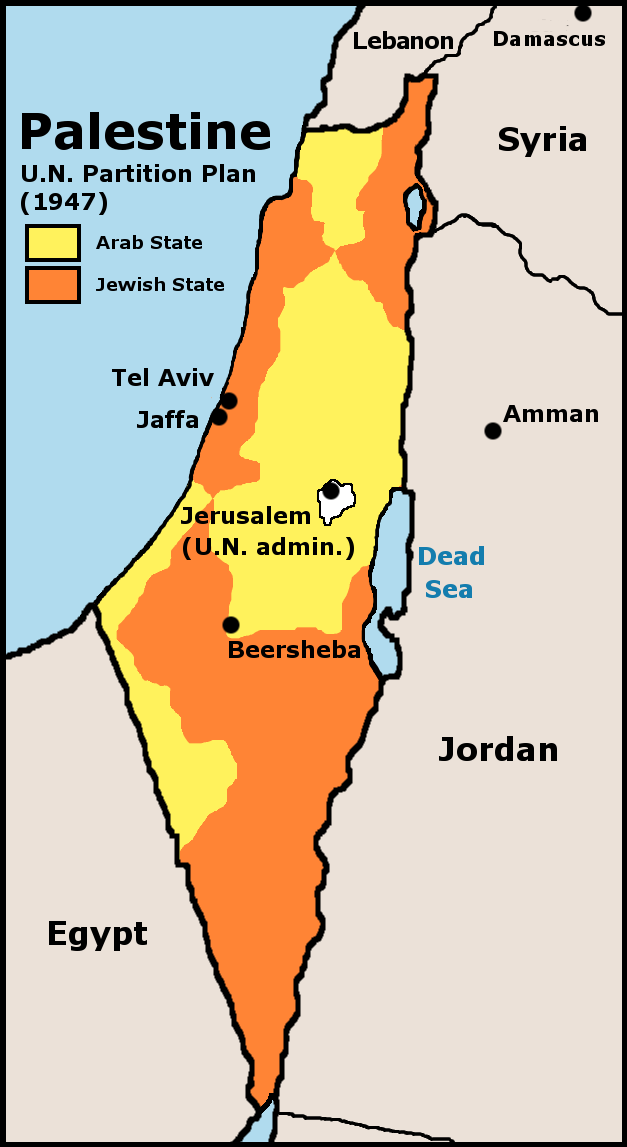
Going back to 1947: The U.N Partition plan for the division of Palestine is shown below:

The Palestinians refused to accept this partitioning. The first phase of the war officially starts the day after the UN General Assembly took vote over this plan on May 14th 1947.

Quickly fighting took place among the Jewish and Arab communities in Palestine. In the first two months there were already 2000+ casualties. As January arrived in 1948, the battles become much more militarized and neighboring Arab allies joined the Arab forces. The Arab forces were now composed of Egypt, Iraq, Syria, Transjordan, Lebanon, Saudi Arabia, and the Arab Liberation Army.

The war was divided into five phases due to temporary truces that took place. During each phase the Israeli military, determined, worked on building up numbers. By the fifth and last phase, every 6th Israeli was enlisted.

The end result was a victory for Israel and hundreds of thousands of Arab refugees which were expelled from their homes.
"Israel views the 1948 refugees as hostile persons sympathetic with a belligerent aggressor."

Refugee camp in lebanon:


So while this war resulted in forcing many Arab Palestinians to find a home elsewhere in the neighboring countries, it also marks the day of Independence which is heavily celebrated in Israel as the sheer determination and dedication of all the Israeli Zionists who fought to claim Israel.


In my opinion, if the Jews weren't underestimated by the neighboring countries, they could've each committed more forces in order to defeat the Jews and end the war in an earlier phase. But that was obviously not the case.
-Roy B


http://www.mideastweb.org/refugees1.htm

https://history.state.gov/milestones/1945-1952/arab-israeli-war

https://en.wikipedia.org/wiki/1948_Palestine_war

https://history.state.gov/milestones/1945-1952/arab-israeli-war

https://en.wikipedia.org/wiki/Nakba_Day

Friday, March 3, 2017

Walls and the Middle East


In the summer of 2017, Turkey expects to complete a 511km concrete wall along its border with Syria.  Turkey hopes the wall will prevent militants, including ISIS and Syrian Rebels, from crossing it borders.  Despite its previous open-door policy, Turkey aims to use the wall to combat smuggling and illegal immigration.  Throughout the Middle East and their European neighbors, walls and fences have been erected at an alarming rate with seven new barriers constructed in 2015 alone. 
  

 Within the Middle East, there is a fence between Saudi Arabia and Yemen and Iraq, Egypt and Israel, and the more contested walls between Israel and the Palestinian territories.  There is a surprisingly short and bloody history to the Israeli walls.  

In 1996, walls were constructed along the Israeli border with the Gaza Strip in order to prevent the entry of arms into Gaza.  The barrier then was torn down by Palestinians in 2000 during an uprising.  By June of 2001, the wall was rebuilt.  Finding wall destruction unviable, Palestinian militants have fired rockets and mortars over the wall since its erection despite a 2008 war with Israel.  Later, Egypt constructed a similar wall on its Gaza border essentially blocking the entire land border of Gaza.  A barrier also separates the West Bank.  The barrier does not follow the previously defined borders and juts into the West Bank at several locations.


While walls in the Middle East are focused on security against militants, walls in Europe are concerned with preventing refugees from entering their territories.  Some of the first of these barriers appeared between Spain and Morocco.  Two Spanish cities, Ceuta and Melilla, located in Morocco saw an influx of African refugees in 2005.  Spain reinforced its fences and effectively stemmed the entrance of refugees.  Refugees then shifted routes to the Canary Island which Spain then reinforced.  

This process continued, refugees change routes, the country blocks that route, and refugees shift their routes, throughout the Balkans.  Even Norway constructed a barrier along its border with Russia to prevent the entry of migrants.  In France and Germany, walls have been erected around refugee camps and residencies as well.  With most routes essentially blocked, refugees must cross the Mediterranean and hope to reach the other side.

Jarred Waters


Turkey-Iran Relations


Recent developments in the Syrian Crisis have precipitated a rising diplomatic tension between Iran and Turkey which led to accusations of appeal to “Persian nationalism” and “sectarian policies” in Iranian efforts to promote national interests in Iraq and Syria. Some say Turkish Iranian relations have been simmering for years in part due to the natural tension caused by the sectarian issue but opposing views over Iraq and Syria have caused tensions to heat further. Here are the opposing views:
          Turkey: Turkey saw the Syrian Crisis as an opportunity for expansion of influence and Sunni Turkey also has no desire for either a strong Shiite or independent Kurdish presence along its southern border (currently Syria). Avoidance of an independent Kurdish presence comes from the fear that international recognition of Syrian and Iraqi Kurds could lead to restlessness among Kurdish citizens of Turkey. Turkey has promoted this self-interest through an indirect support for rebel forces.
          Iran: Shiite Iran, on the other hand, views Syria and Iraq as a vital sphere of influence and buffer to surrounding Sunni nations and therefore feels threatened by Turkish involvement in a possible regime change. Iran, in response, has backed Assad’s authority, along with Russia, providing support against ISIL and anti-Assad rebels.
-‘"Iran is extremely disturbed by Turkey's Euphrates Shield operation in Syria and its military presence in Iraq's Bashiqa," Erdem Aydin, an expert on Iran at Istanbul's Bogazici University, told Al Jazeera.’

Despite this escalation, most experts do not seem worried about tensions boiling over. The Turkish Iranian border is one of the oldest international borders, formed in 1639 by the Qasr-i Shirin Treaty. Iranian President Hassan Rouhani recently expressed interest in expanding Turkish Iranian relations while highlighting recent improvements such as a preferential trade agreement and co-signed cooperation agreements on various fields of government. Perhaps the strongest deterrent to conflict for both sides, Turkish Iranian economic relations have become a heavily vested mutual interest:
‘“90 percent of Iran's natural gas exports go to Turkey and Turkey imports 20 percent of its natural gas from Iran, " Aydin told Al Jazeera. "Regional politics may cause tensions between the two countries, but in the light of their strong economic ties, I don't believe the recent escalation in diplomatic tensions is going to lead to a serious confrontation."’
-Noah O'Kelley

http://www.aljazeera.com/indepth/features/2017/02/hostility-iran-turkey-170225184418231.html
http://www.eurasiareview.com/02032017-turkish-iranian-relations-hit-turbulence-oped/
https://www.tasnimnews.com/en/news/2017/03/01/1343461/president-rouhani-closer-iran-turkey-relations-to-serve-regional-stability
https://www.americanprogress.org/issues/security/reports/2016/07/11/140959/turkey-iran-relations/