Thursday, March 9, 2017

Nike's Pro Hijab

by Nicolette Mehran

            As we all know, much of the Middle East follows the beliefs of Islam. In some countries, it is required by law that women cover themselves from head to toe, but in others, it is not, despite the fact that some women choose to cover themselves anyway. However, Muslim women are not just confined to the Middle East; they exist all around the world and are some of the most powerful, accomplished women in the world as well, taking on roles as government officials, activists, educators and scholars, and professional athletes. However, for athletes in particular, wearing a hijab can become quite difficult and cumbersome. But, Nike found a solution.

Ibtihaj Muhammad

            Professional fencer Ibtihaj Muhammad was the first Muslim United States athlete to compete in the Olympics while wearing a hijab, paving the way for women to follow in her footsteps and empowering women around the world to be proud of their heritage and their beliefs. However, Muhammad has stated that, because of her modest Muslim apparel, she has had a hard time feeling like part of a team or finding clothing that was appropriately suited for athletic purposes. However, Nike, a company that knows how clothing can affect an athlete, has decided to take matters into its own hands and created what it calls a “Pro Hijab” for Muslim women that will be launched in Spring 2018. It is made of a breathable material that helps to wick away sweat, featuring an elastic band that allows for adjustment for various activities or wear underneath another athletic garment. This product was tested by several Middle Eastern women from various athletic fields such as Zahra Lari (a figure skater), Manal Rostom (a runner), and Amna Al Haddad (a weight-lifter). This hijab is part of Nike’s new campaign for Middle Eastern women that highlights five female professional athletes with the slogan “What will they say about you?”, a question many women in the region face on a regular basis.

Zahra Lari

Manal Rostom

            Day by day, women prove themselves to be smart, powerful, and worthy of everything the world has to offer, and Nike’s doing this is a great way to empower women across the Middle East, and across the world, to start believing in themselves more. Women deserve to have the same opportunities and rights that men have, regardless of their beliefs, abilities, knowledge, or gender. 

Sources
http://money.cnn.com/2017/03/07/news/nike-pro-hijab/index.html
https://www.nytimes.com/2017/03/08/fashion/nike-pro-hijab-muslim-athlete.html?_r=0
http://www.npr.org/sections/thetorch/2016/08/05/488435043/an-american-muslim-fencer-lunges-into-u-s-olympic-history-in-rio
http://www.dw.com/en/win-or-lose-nike-launches-pro-hijab/a-37869127

Saturday, March 4, 2017

Israel's War for Independence

In class we discussed the Nakba or "Catastrophe" which is a day remembered yearly on May 15th. Another special day that occurs approximately during the same time is "Yom Ha'atzmaut" or Independence Day in Hebrew. Both of these days were primary a result of Israel's War of Independence.

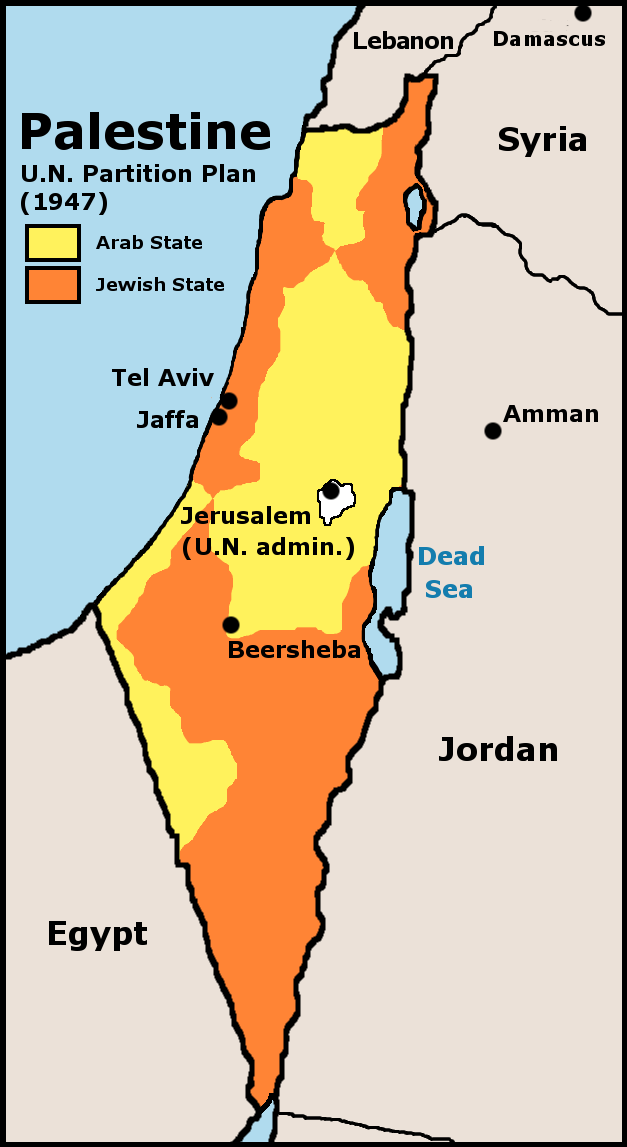
Going back to 1947: The U.N Partition plan for the division of Palestine is shown below:

The Palestinians refused to accept this partitioning. The first phase of the war officially starts the day after the UN General Assembly took vote over this plan on May 14th 1947.

Quickly fighting took place among the Jewish and Arab communities in Palestine. In the first two months there were already 2000+ casualties. As January arrived in 1948, the battles become much more militarized and neighboring Arab allies joined the Arab forces. The Arab forces were now composed of Egypt, Iraq, Syria, Transjordan, Lebanon, Saudi Arabia, and the Arab Liberation Army.

The war was divided into five phases due to temporary truces that took place. During each phase the Israeli military, determined, worked on building up numbers. By the fifth and last phase, every 6th Israeli was enlisted.

The end result was a victory for Israel and hundreds of thousands of Arab refugees which were expelled from their homes.
"Israel views the 1948 refugees as hostile persons sympathetic with a belligerent aggressor."

Refugee camp in lebanon:


So while this war resulted in forcing many Arab Palestinians to find a home elsewhere in the neighboring countries, it also marks the day of Independence which is heavily celebrated in Israel as the sheer determination and dedication of all the Israeli Zionists who fought to claim Israel.


In my opinion, if the Jews weren't underestimated by the neighboring countries, they could've each committed more forces in order to defeat the Jews and end the war in an earlier phase. But that was obviously not the case.
-Roy B


http://www.mideastweb.org/refugees1.htm

https://history.state.gov/milestones/1945-1952/arab-israeli-war

https://en.wikipedia.org/wiki/1948_Palestine_war

https://history.state.gov/milestones/1945-1952/arab-israeli-war

https://en.wikipedia.org/wiki/Nakba_Day

Friday, March 3, 2017

Walls and the Middle East


In the summer of 2017, Turkey expects to complete a 511km concrete wall along its border with Syria.  Turkey hopes the wall will prevent militants, including ISIS and Syrian Rebels, from crossing it borders.  Despite its previous open-door policy, Turkey aims to use the wall to combat smuggling and illegal immigration.  Throughout the Middle East and their European neighbors, walls and fences have been erected at an alarming rate with seven new barriers constructed in 2015 alone. 
  

 Within the Middle East, there is a fence between Saudi Arabia and Yemen and Iraq, Egypt and Israel, and the more contested walls between Israel and the Palestinian territories.  There is a surprisingly short and bloody history to the Israeli walls.  

In 1996, walls were constructed along the Israeli border with the Gaza Strip in order to prevent the entry of arms into Gaza.  The barrier then was torn down by Palestinians in 2000 during an uprising.  By June of 2001, the wall was rebuilt.  Finding wall destruction unviable, Palestinian militants have fired rockets and mortars over the wall since its erection despite a 2008 war with Israel.  Later, Egypt constructed a similar wall on its Gaza border essentially blocking the entire land border of Gaza.  A barrier also separates the West Bank.  The barrier does not follow the previously defined borders and juts into the West Bank at several locations.


While walls in the Middle East are focused on security against militants, walls in Europe are concerned with preventing refugees from entering their territories.  Some of the first of these barriers appeared between Spain and Morocco.  Two Spanish cities, Ceuta and Melilla, located in Morocco saw an influx of African refugees in 2005.  Spain reinforced its fences and effectively stemmed the entrance of refugees.  Refugees then shifted routes to the Canary Island which Spain then reinforced.  

This process continued, refugees change routes, the country blocks that route, and refugees shift their routes, throughout the Balkans.  Even Norway constructed a barrier along its border with Russia to prevent the entry of migrants.  In France and Germany, walls have been erected around refugee camps and residencies as well.  With most routes essentially blocked, refugees must cross the Mediterranean and hope to reach the other side.

Jarred Waters


Turkey-Iran Relations


Recent developments in the Syrian Crisis have precipitated a rising diplomatic tension between Iran and Turkey which led to accusations of appeal to “Persian nationalism” and “sectarian policies” in Iranian efforts to promote national interests in Iraq and Syria. Some say Turkish Iranian relations have been simmering for years in part due to the natural tension caused by the sectarian issue but opposing views over Iraq and Syria have caused tensions to heat further. Here are the opposing views:
          Turkey: Turkey saw the Syrian Crisis as an opportunity for expansion of influence and Sunni Turkey also has no desire for either a strong Shiite or independent Kurdish presence along its southern border (currently Syria). Avoidance of an independent Kurdish presence comes from the fear that international recognition of Syrian and Iraqi Kurds could lead to restlessness among Kurdish citizens of Turkey. Turkey has promoted this self-interest through an indirect support for rebel forces.
          Iran: Shiite Iran, on the other hand, views Syria and Iraq as a vital sphere of influence and buffer to surrounding Sunni nations and therefore feels threatened by Turkish involvement in a possible regime change. Iran, in response, has backed Assad’s authority, along with Russia, providing support against ISIL and anti-Assad rebels.
-‘"Iran is extremely disturbed by Turkey's Euphrates Shield operation in Syria and its military presence in Iraq's Bashiqa," Erdem Aydin, an expert on Iran at Istanbul's Bogazici University, told Al Jazeera.’

Despite this escalation, most experts do not seem worried about tensions boiling over. The Turkish Iranian border is one of the oldest international borders, formed in 1639 by the Qasr-i Shirin Treaty. Iranian President Hassan Rouhani recently expressed interest in expanding Turkish Iranian relations while highlighting recent improvements such as a preferential trade agreement and co-signed cooperation agreements on various fields of government. Perhaps the strongest deterrent to conflict for both sides, Turkish Iranian economic relations have become a heavily vested mutual interest:
‘“90 percent of Iran's natural gas exports go to Turkey and Turkey imports 20 percent of its natural gas from Iran, " Aydin told Al Jazeera. "Regional politics may cause tensions between the two countries, but in the light of their strong economic ties, I don't believe the recent escalation in diplomatic tensions is going to lead to a serious confrontation."’
-Noah O'Kelley

http://www.aljazeera.com/indepth/features/2017/02/hostility-iran-turkey-170225184418231.html
http://www.eurasiareview.com/02032017-turkish-iranian-relations-hit-turbulence-oped/
https://www.tasnimnews.com/en/news/2017/03/01/1343461/president-rouhani-closer-iran-turkey-relations-to-serve-regional-stability
https://www.americanprogress.org/issues/security/reports/2016/07/11/140959/turkey-iran-relations/

Thursday, February 23, 2017

Saudi Arabia's first Comic con


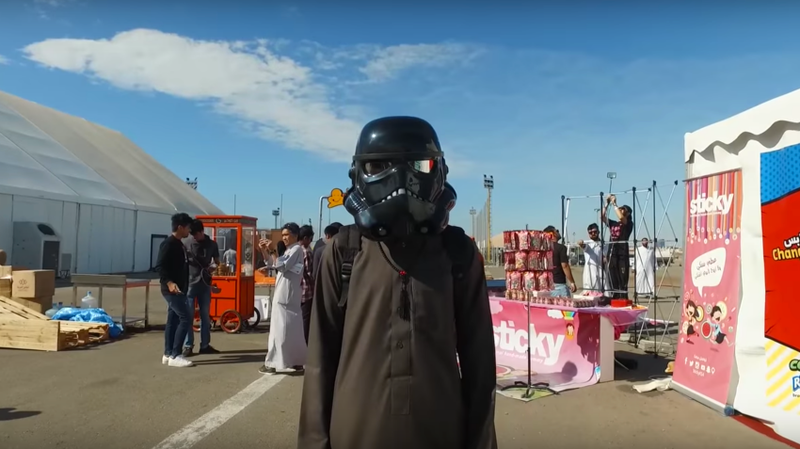
Last weekend, on February 16-18th, Saudi Arabia had its first Comic Con, where participants got to dress up like their favorite comic characters and meet actors from their favorite TV shows. You might read this and think okay… so what. Well it turns out this convention has become somewhat of a controversial topic among Saudi Arabians, and there was even a trending hashtag on twitter that called Comic con a “devil worshipping” gathering. Seems harsh right? This condemnation of the convention comes perhaps from the fact that comic cons are very western and celebrate fake heroes, but also because of the way in which this particular comic con went about, specifically the integration of men and women throughout the festival. It is typical practice for men and women to be segregated in public, however, at this event, the men and women could walk around the comic con tent to wherever they pleased. Another possible reason for the denunciation by Saudi Arabians is that the convention promotes public fandom of television and movies, and movie theatres are outlawed in Saudi Arabia. I think it’s safe to say the twitter attackers of the convention are afraid of a change in social and gender norms.
Attendees dress up and genders mix at Saudi Arabia's first Comi Con.

The government of Saudi Arabia was actually the group that sponsored the event. Comic con was a part of their “Vision 2030” plan, a dream for the future that Saudi Arabia will be the “heart of the Arab world” with a diversified economy, and be a welcoming, tolerant nation with its foundations and laws still firmly based on Islam. To me, this first Comic con was a great way to let people publically celebrate their enthusiasm for their own personal interests, and will hopefully follow with even more opportunity for social freedoms in the future.


-Olive McKay


Sources
http://www.cnn.com/2017/02/19/middleeast/saudi-arabia-comic-con/index.html
http://vision2030.gov.sa/en/foreword
http://www.dailymail.co.uk/wires/afp/article-4253898/Saudis-Comic-Con-fest-penalised-violation.html
http://io9.gizmodo.com/saudi-arabia-holds-kingdoms-first-comic-con-1792550647

Photos
http://www.cnn.com/2017/02/19/middleeast/saudi-arabia-comic-con/index.html
http://io9.gizmodo.com/saudi-arabia-holds-kingdoms-first-comic-con-1792550647


Wednesday, February 22, 2017

Israeli - Palestinian Two State Debate

I found this current predicament particularly interesting in light of our recent discussion of the Paris Peace Conference’s influence on the state make-up of the Middle East. It seems the concerns and issues with the somewhat arbitrarily crafted boarders are still quite lively today.

To fully understand the current debate, it is important to look at the partitioning of land since World War I. In 1921, Transjordan was officially separated from what is now the state of Israel and the West Bank and was awarded to Emir Abdullah in an attempt to appease Arab forces (1). After Israel declared independence in 1948, and claimed the West Bank to be included in its territories, the Arab League members of Egypt, Syria, Transjordan and Lebanon went on the offensive and Lebanon took control of the West Bank (2). Twenty years later, after repeated aggression from Syrian, Jordanian, and Egyptian militant forces, Israel went on the offensive, capturing West Bank, Golan Heights of Syria, and Sinai of Egypt in the Six Day War of 1967. In an expressed attempt to promote peace with its neighbors, Israel relinquished control of all captured lands except for West Bank, wherein it established a military administration (3). Though this move was presented as an attempt for peace, Israel wanted authority over the West Bank without having to give its largely Arab population a voice in the government. Thus, the West Bank and its population came under Israeli control without being incorporated into its state.

Since 1967, the debate on what to do with the West Bank has taken many different forms, but has been centrally focused on the statehood or non-statehood of the Palestinian community in West Bank. The relevant territories and the population distributions are shown on the map below.


Two State Solution
The current proposed two state solution, wherein a West Bank would become an autonomous Palestinian territory, has had the support of the majority of Israeli prime ministers since 1974, though legitimate action has never materialized. Part of the issue is that numerous Palestinian nationalists claim the entire territory of from the River Jordan to the Mediterranean should be under Islamic rule, and are unwilling to engage in negotiations with the Israeli government. Another significant portion of the issue is that the debate has remained entirely political and no leaders have put any conclusive stance into action (3).

One State Solution
The current proposed one state solution, originally powered by religious and ethnic claims to the West Bank territory, now hinges on the reality that it would be a nightmare to evacuate the 400,000 Jewish settlers in the West Bank if a two state solution was instigated. Individuals that side with the one state solution also argue that a single state is possible and would bring unity to the entirety of West Bank and Israeli citizens. However, some argue that the rising Arab population would soon lead to a majority Arab population, meaning the Israeli Jews would lose autonomy in their own nation state if the West Bank was fully incorporated (3).

The entire debate has become more and more complicated recently with drastic changes in the United State’s political climate and the political climate in Israel. The firm two state solution, which has for many years been a cornerstone of US policy in the area, has been vaguely softened by President Donald Trump, who recently stated, “If Israel and the Palestinians are happy, I’m happy with whichever one they like best (4).” Furthermore, the Israeli prime minister Netanyahu, who previously stated support for the two state solution, has recently been hardening his stance against Palestinian statehood after the staunch urging of Israeli’s minister of education, Naftali Bennett (5). This hardening has recently climaxed in the passing of the Regulation Law, allowing Jewish settlements to be built in West Bank territory on private Palestinian land. This is the first time since 1967 that Israel has extended Israel legislation into the West Bank, signifying a shift toward the sentiment that Israel has full authority over West Bank territory. Another legislation is currently in the making to annex the settlement of Ma’ale Adumim, a large suburb to the east of Jerusalem in the West Bank, into Israel’s possession (6).


Israel’s recent moves signify a growing shift away from the establishment of a Palestinian state and a growing sentiment that the West Bank is territory that can be handled as Israel sees fit. It also highlights the lack of voice that Palestinians who are occupying the West Bank have in the matter, and though President Trump wishes for a solution where both sides are “happy,” there seems to be no one listening to the Palestinian definition of “happy.”

- Squires Dearinger


Sources
http://www.economist.com/news/middle-east-and-africa/21716563-high-court-may-yet-strike-it-down-israels-parliament-passes-controversial

Monday, February 20, 2017

Rap music was first born out of the evolution of the mixing and spinning records. The idea behind it was to take a song, take one part of it, and play it over and over again with a mixture of a sample of another song. At first rapping over this music was just for hyping a crowd up, but eventually artist started to use rapping as a medium to convey a socio-political message. The pioneer of this is Grandmaster Flash and the Furious Five, who made the song “The Message”. This song marks the start of a movement called conscious rap, which is characterized as self-aware music with a social and political message, which took rap to the social platforms with groups such as Public Enemy and NWA. Rap documented the realities of the ghettos within America that was not documented by anybody. The ghettos in America were places that were never talked about, it was not part of America to the general public. Through music, the everyday realities of a man living in the ghettos were documented by rap music. There is a similar movement going on in Palestine. Similarly to how black men voiced their frustration with life in America, Palestinians are also using hip-hop as a medium of expression and addressing frustration that they experience in their communities. This subgenre is an attempt to politicize issues such as the Israel/Palestinian Conflict, the living conditions in Palestine, and Palestinian unity.
They’re a lot of similar themes between hip-hop in the US and Palestinian hip-hop. One of those themes include unity between peers. The African American youth is really prone to join gang activities, which could be attributed to a lot of reasons. Putting more groupings in a small minority makes it challenging for that minority to be heard and taken seriously. The case is similar within Palestine and Islam. While inner city youth in America have Bloods and Crips, the youth of Palestine have the divide within Islam. To combat the divide, Palestinian rappers such as DAM (Da Arab MCs) preach unity with lyrics like “out future is in our hands, there is still good in the work my brothers.”
The Palestinian group DAM

What I find most interesting about this Palestinian hip-hop movement is the anger behind it. As a hip-hop head, I always thought that rap was not inherently angry, and while a genre of music cannot just be angry, there is a tendency for rap to be used for angry self expression. One song that stood out for me was “Born Here” by DAM.  The production on the song involves the presence of a hand-drum and fast Arabic rhythms that complement the melodic tone of Arabic.  The song is really interesting because it is similar to the song  “F*ck tha Police” by NWA. The reason I say that is because in “F*ck  tha Police” a big message is about how the government accuses the black community of wronging society when in reality, the government has wronged them. This is really similar idea in  “Born Here” where one of the MCs says “I broke the law? No, the law broke me.”

I have always thought that hip-hop was a manifestation of the black community creating a new culture. A lot of African Americans do not have a trace of their ancestries or there cultural roots,  so new roots are arising in America. In Palestine, the opposite has happened in a way. Palestinians have not been robbed of their culture, and that is a big theme within the music. They talk about pride for their language and their culture. Shadia Mansour says “no matter how much you oppress me, where you take me off to, my origins stay Arabic,” which is really interesting because the people can rap about their culture while rap in America is culture.

--Chet Sharma

Sources:


DAM official website – www.damrap.com


Iamge - https://i.ytimg.com/vi/CC5_Bj45Z_s/hqdefault.jpg